MIRO Ecosystem August Report
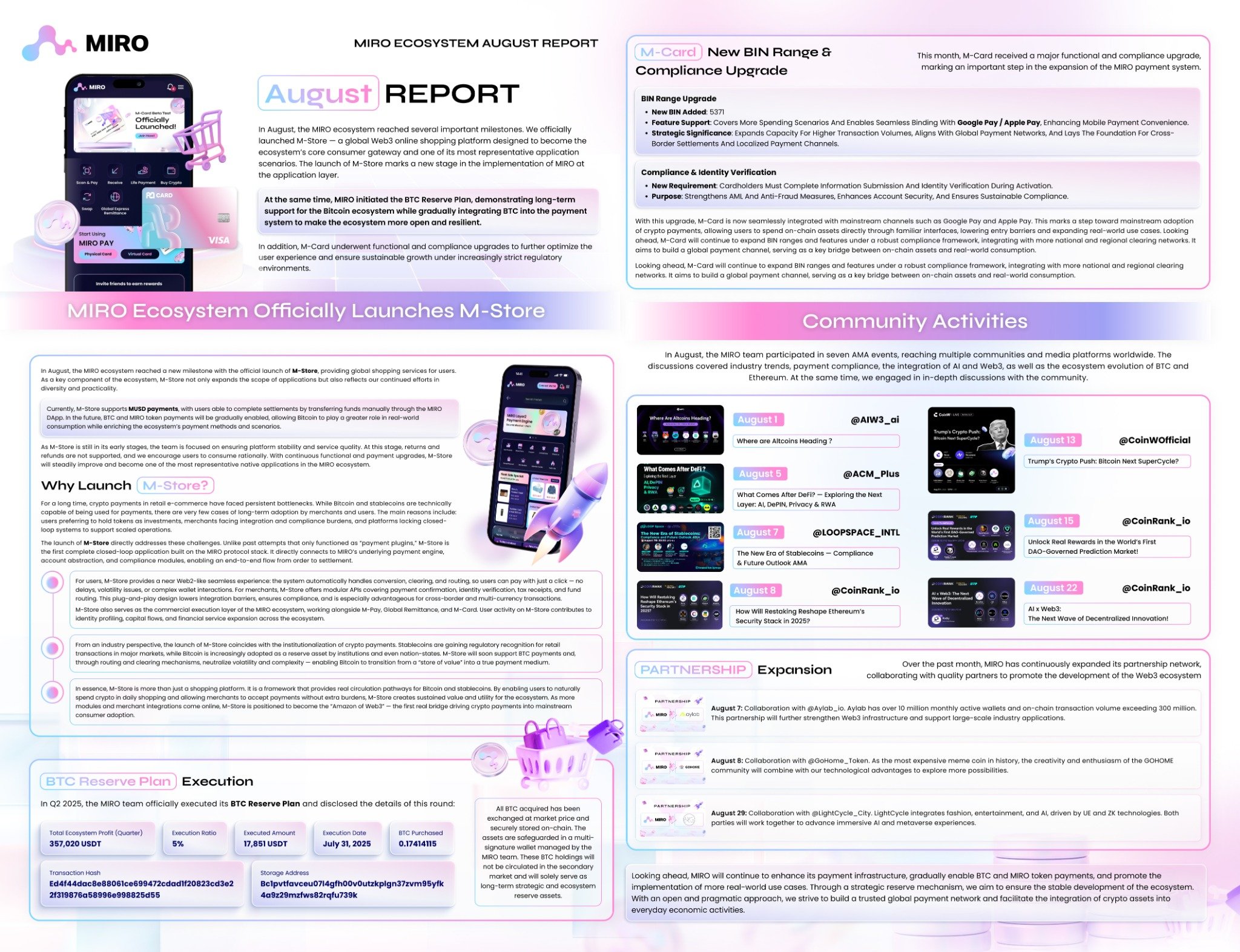
In August, the MIRO ecosystem achieved significant milestone progress. After several months of preparation, we officially launched M-Store — a unique online shopping platform. We aim to make it the “Amazon” of Web3, not only serving as the core consumption entry of the ecosystem but also becoming one of the most representative native application scenarios of MIRO. The launch of M-Store marks a new stage of MIRO’s application layer deployment and signifies further expansion of the ecosystem map.
At the same time, we officially launched the BTC Asset Reserve Plan in August. This initiative represents MIRO’s support and commitment to the long-term development of the Bitcoin ecosystem. We will continue to execute this plan and gradually integrate BTC assets into the payment system. This is not only a strategic layout for BTC but also a key step in making the MIRO ecosystem more open and resilient.
Additionally, this month, M-Card underwent significant upgrades in functionality and compliance, aiming to further optimize the user experience and ensure long-term, stable development under increasingly strict regulatory environments.
MIRO Ecosystem Officially Launches Online Mall M‑Store
In August, the MIRO ecosystem reached a new milestone — we officially launched the online mall M-Store, providing global shopping services to users. As an important component of the MIRO ecosystem, the creation of M-Store not only marks further expansion of the platform’s application layer but also reflects our continuous exploration and breakthroughs in diversity and practicality.
Currently, the mall has first opened MUSD payments. Users can manually transfer funds to the mall account via the MIRO DApp to complete settlement. This initial payment design leaves room for future upgrades. In the future, we will gradually open BTC and MIRO token payments, allowing Bitcoin to better realize value and circulation in real consumption scenarios, while further enriching the payment methods and application scenarios of the MIRO ecosystem.
It should be noted that the mall is still in its early operational stage, and the team is fully committed to ensuring overall stability and service experience. Therefore, return and exchange services are temporarily unavailable at this stage, and we hope users consume rationally. M-Store continues the design philosophy of simplicity and efficiency, aiming to provide a stable and smooth shopping experience for global users. With continuous upgrades in functionality and the payment system, the mall will gradually become one of the most representative native application scenarios in the MIRO ecosystem.
Why Launch M-Store?
In fact, we have observed that for a long time, attempts at crypto payments in the retail e-commerce sector have always faced bottlenecks.
Although Bitcoin and stablecoins are already capable of payment, cases of long-term adoption by merchants and users are scarce. From Overstock accepting BTC in 2014, to Shopify integrating thousands of crypto payment plugins in 2021, to PayPal launching PYUSD payments in 2024, each exploration generated discussion waves, but ultimately failed to exceed 0.1% actual usage.
The reason is not complicated: users tend to hold coins for investment rather than consumption, merchants face integration and compliance pressures, and platforms themselves lack a closed-loop system capable of supporting scaled operations.
Our initial intention in launching M-Store is to solve these difficulties and fully leverage MIRO’s underlying architecture to create new possibilities in crypto e-commerce, while establishing it as a typical application scenario within the ecosystem.
Unlike previous crypto e-commerce platforms that merely act as a “payment plugin,” M-Store is the first “complete closed-loop” application of the MIRO payment protocol stack at the application layer. It is embedded in the MIRO payment system, directly invoking the underlying payment execution engine, account abstraction mechanism, and compliance modules to achieve a fully connected chain from ordering to settlement, truly transforming crypto payment into a stable, reusable business behavior.
M-Store serves both ends of the crypto e-commerce ecosystem.
For users, M-Store offers a “frictionless experience.” In the past, crypto e-commerce shopping required dealing with on-chain confirmation delays, price volatility, and complex wallet interactions, resulting in an experience far inferior to traditional e-commerce. Within M-Store, the system automatically handles conversion, settlement, and routing via the execution engine, allowing users to complete the entire process with a simple click as in traditional platforms. This “Web2-like experience + Web3 backend logic” design allows crypto payments to finally match traditional payment usability.
For merchants, M-Store provides a modular, plug-and-play service system. Merchants can use standard APIs to access payment confirmation, identity verification, tax receipts, and fund routing without building wallet systems or handling on-chain accounts themselves. This “plug-and-play” architecture greatly lowers integration thresholds while ensuring compliance and audit requirements are met. Especially in cross-border and multi-currency settlement scenarios, M-Store’s modular design retains flexibility for merchants and opens new markets.
At the same time, M-Store serves as the “commercial execution layer” of the MIRO ecosystem. It collaborates with M-Pay, Global Express, M-Card, and other modules to form a complete payment stack. User consumption in M-Store will further trigger identity profiling and subsequent financial services. In other words, M-Store not only serves shopping scenarios but also supports the ecosystem with data, cash flow, and user engagement.
From an industry perspective, the launch of M-Store coincides with the institutionalization of crypto payments. With major markets like the US and EU gradually introducing stablecoin regulatory frameworks, stablecoins are gaining legal compliance status in retail transactions, giving crypto assets mainstream commercial legitimacy. Meanwhile, the trend of Bitcoin being included in institutional and national reserves is increasingly evident, making the release of BTC’s payment attributes a focal point of the industry. M-Store will directly support BTC payments and, through routing and settlement mechanisms, mitigate price volatility and integration complexity, transforming Bitcoin from a “store of value” into a true “payment medium.”
This may be the strategic significance of M-Store: it is expected to become a framework providing real circulation paths for Bitcoin and stablecoins. Through this framework, users can naturally use crypto assets in daily shopping, merchants can receive payments and comply without extra burden, and the ecosystem can accumulate continuous data and revenue.
In the future, as more payment modules, compliance modules, and merchant integration capabilities are gradually improved, M-Store is expected to become the “Amazon” of the Web3 world, serving as the first bridge to bring crypto payments into mainstream consumption.
BTC Reserve Plan Execution
The MIRO team officially executed the BTC Reserve Plan in Q2 2025 and disclosed the specific data for this round:
Total quarterly ecosystem profit: 357,020 USDT
Execution ratio for this round: 5%
Execution amount: 17,851 USDT
Execution date: July 31, 2025
BTC purchased: 0.17414115
Transaction hash: ed4f44dac8e88061ce699472cdad1f20823cd3e22f319876a58996e998825d55
Storage address: bc1pvtfavceu07l4gfh00v0utzkplgn37zvm95yfk4a9z29mzfws82rqfu739k
All purchased BTC have been exchanged at market prices and stored on-chain. This batch of BTC is securely held by the MIRO team in a multi-signature wallet, does not participate in secondary market circulation, and is used solely as a long-term strategic and ecosystem reserve asset.
M-Card New BIN and Compliance Requirements
This month, M-Card underwent a phased upgrade in both functionality and compliance. This upgrade represents an important step in MIRO’s expansion of its payment system and compliance framework.
BIN Upgrade Details
New BIN: 5371
Supported Functions: This BIN covers more consumption scenarios and can be seamlessly linked with Google Pay / Apple Pay, further enhancing mobile convenience.
Strategic Significance: Expanding the BIN is not merely a technical update, but a necessary choice as user scale grows and application scenarios diversify. With the new BIN, M-Card can handle higher transaction volumes and better integrate with global mainstream payment networks, laying the foundation for future cross-border settlement and localized payment channels.
Compliance and Identity Verification
New Requirement: According to the latest compliance standards, cardholders must complete KYC (identity verification) by entering their information and passing the verification process upon activation.
Rationale: The global crypto payment system is rapidly institutionalizing, and identity verification and fund transparency have become industry consensus. By strengthening KYC, M-Card can better meet AML, anti-fraud, and other regulatory requirements while enhancing overall account security, providing users with a more trustworthy card environment.
This upgrade enables virtual cards and on-chain payments to achieve seamless integration with mainstream channels like Google Pay and Apple Pay. This signifies that crypto payments are gradually moving from niche scenarios to mainstream consumer channels. Users can directly utilize on-chain assets for payments through familiar interfaces, lowering the entry barrier and expanding practical usage. Meanwhile, we continue to emphasize balancing user experience and regulatory requirements, because only under safe and compliant conditions can broader adoption be supported. This M-Card upgrade is a key step based on this balance.
Looking ahead, the M-Card iteration not only optimizes existing user experience but also lays the foundation for future expansion. As more BINs and payment functions are launched, M-Card will continue to explore integration with local clearing networks in different countries under the compliance framework, gradually building a global payment channel. In this process, M-Card will serve not only as a payment tool but also as a crucial gateway connecting on-chain assets with real-world consumption, facilitating the adoption and growth of the MIRO ecosystem in broader markets.
Community Activities
In August, the MIRO team participated in seven AMA events, covering multiple global communities and media platforms. The discussions revolved around industry trends, payment compliance, the convergence of AI and Web3, as well as the evolution of BTC and Ethereum ecosystems. At the same time, we also engaged in in-depth conversations with the community.
Host: @AIW3_ai
Date: August 1
Topic: Where are Altcoins Heading?

Host: @ACM_Plus
Date: August 5
Topic: What Comes After DeFi? — Exploring the Next Layer: AI, DePIN, Privacy & RWA

Host: @LOOPSPACE_INTL
Date: August 7
Topic: The New Era of Stablecoins — Compliance & Future Outlook AMA

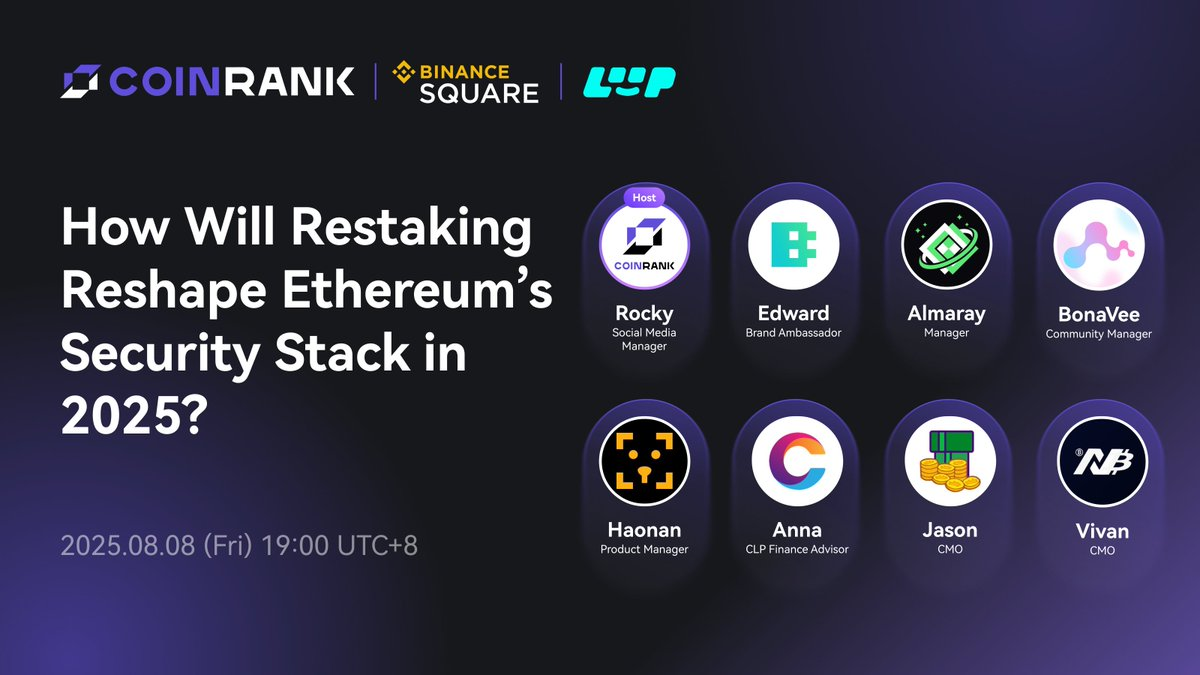
Host: @CoinRank_io
Date: August 8
Topic: How Will Restaking Reshape Ethereum’s Security Stack in 2025?
Host: @CoinWOfficial
Date: August 13
Topic: Trump’s Crypto Push: Bitcoin Next SuperCycle?

Host: @CoinRank_io
Date: August 15
Topic: Unlock Real Rewards in the World’s First DAO-Governed Prediction Market!

Host: @CoinRank_io
Date: August 22
Topic: AI x Web3: The Next Wave of Decentralized Innovation!

Partnerships and Expansion
Over the past month, we have continued to expand our partnership network, joining hands with high-quality partners to jointly drive the growth of the Web3 ecosystem.
August 7 — Partnership with @Aylab_io
Aylab is a driving engine for Web3 scalability — with over 10 million monthly active wallets, more than 300 million on-chain transactions, and coverage across protocols, dApps, and multiple blockchains.
This collaboration will further strengthen Web3 infrastructure development and accelerate the industry’s transition into large-scale adoption.

August 8 — Partnership with @GoHome_Token
GOHOME TOKEN is the most expensive meme coin in history — starting as a joke, fueled by chaos, and driven by a bold community daring to challenge Bitcoin.
This collaboration will merge the creativity and passion of the community with our technological strengths, sparking brand-new possibilities.

August 29 — Partnership with @LightCycle_City
LightCycle is a next-generation metaverse ecosystem that integrates fashion, entertainment, and artificial intelligence, powered by Unreal Engine + ZK technology.
Together, we aim to bring AI and metaverse applications into reality, creating an immersive next-generation digital experience.

Looking ahead, MIRO will continue to build around its core mission of payment infrastructure, steadily advancing application development and compliance modules.
We plan to gradually expand BTC and MIRO token payment support, further enhance the M-Store experience, and enable more real-world commercial scenarios. Meanwhile, our BTC strategic reserve mechanism will continue to operate in a structured and transparent way, supporting the ecosystem’s long-term stability and value accumulation.
As global crypto payments move toward compliance and scalability, MIRO will adopt a more open and pragmatic approach to build a trustworthy, sustainable, and scalable payment network, helping crypto assets truly integrate into everyday economic activity.
We look forward to working hand in hand with the community and our partners to witness the future growth of the MIRO ecosystem.