MIRO Ecosystem May Report
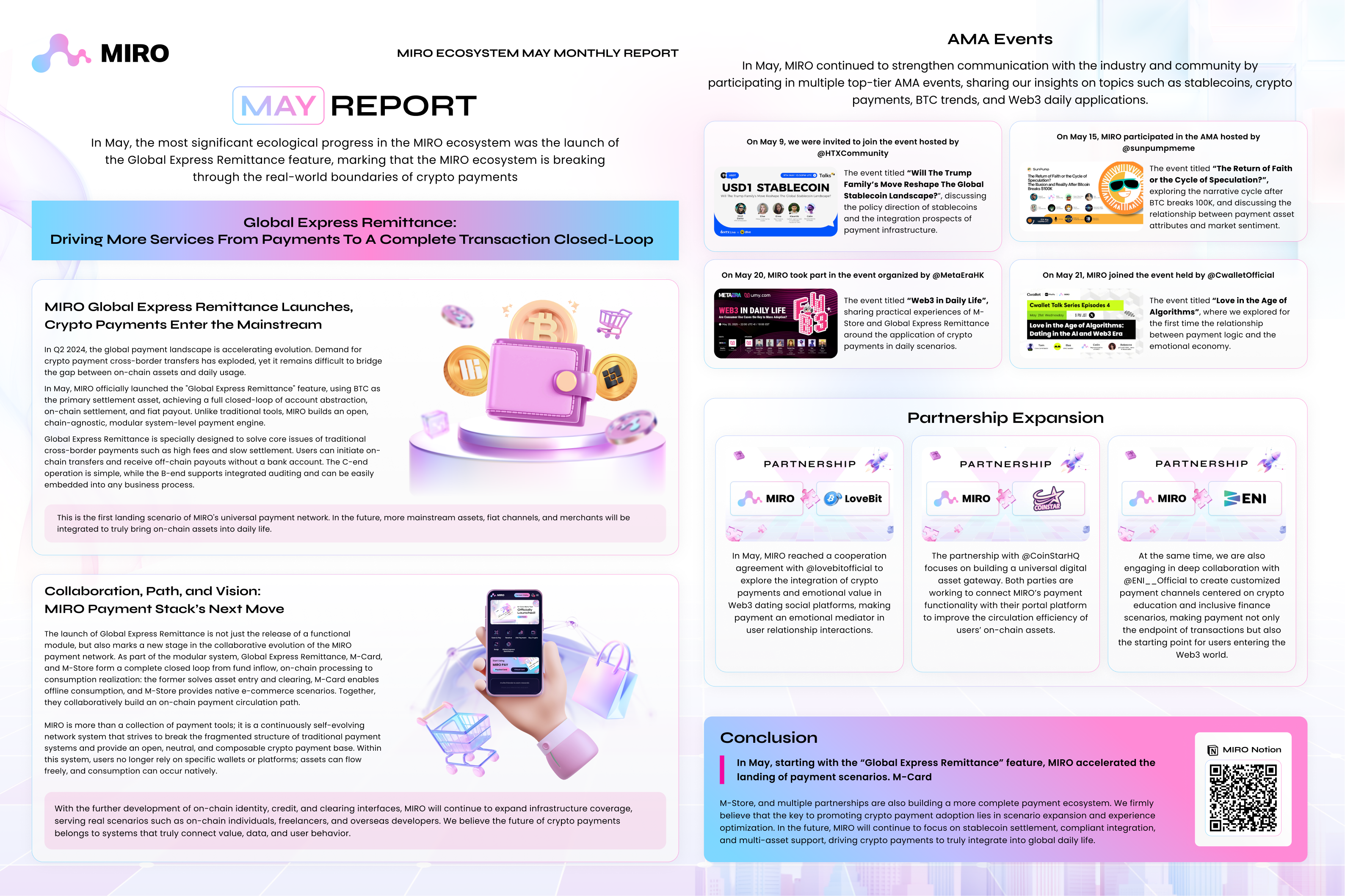
In May, the most significant development in the MIRO ecosystem was the launch of the Global Remittance feature, marking a major step toward bridging the gap between crypto payments and real-world use cases.
Global Remittance Feature: Driving Services From Payments to a Complete Transaction Loop
As we enter Q2 2024, the global payment industry is undergoing a phase of structural acceleration. We continue to see the circulation of stablecoins grow, and as cross-border remittance demand surges, crypto payments are moving from the fringe to the mainstream. For most users, however, “crypto payments” still remain at a conceptual level or within closed ecosystems. Whether it's a DApp payment button inside a wallet or a lightweight transfer function from a centralized exchange, the experience is still far from realizing a seamless connection between on-chain assets and everyday transactions.
In May, we officially launched the “Global Remittance” feature — a key component in MIRO’s payment network that completes the loop of account abstraction, smart risk control, on-chain settlement, and fiat mapping. Unlike most offerings on the market that present as “personalized tools” or “wallet modules,” MIRO is building a universal, system-level payment engine. It features chain-agnostic architecture, non-custodial neutrality, and modular expandability — a true Web3 financial infrastructure rather than an add-on to a specific app.
We prioritized launching “Global Remittance” because it directly addresses structural pain points in traditional payment systems: high fees, slow transfers, multiple intermediaries, and fragmented exchange rates. In many economies and user groups that depend on cross-border transactions, these are no longer inconveniences but real barriers to survival and growth. According to data from the World Bank and BIS, the global average cost of cross-border remittance is 6.62%, with settlement times typically ranging from 2 to 5 business days. These are the first-principles problems the MIRO system aims to solve.
MIRO’s Global Remittance module uses BTC as the main settlement asset. Paired with our proprietary settlement logic and risk control system, it enables users to operate on-chain while receiving fiat off-chain in near real time. The entire process requires no bank account, no multi-layer clearance — just “on-chain invocation + smart distribution,” drastically reducing both the learning curve and operational complexity. For retail users, this means a significantly improved user experience; for business users, it offers a new interface for payment integration: embeddable, composable, and auditable.
At the same time, MIRO’s Global Remittance is not just an isolated feature — it’s the first real-world implementation of our vision for a universal payment network. We believe that “payment” is essentially a connection mechanism, not a proprietary service. In this logic, we reject locking users and assets into a single wallet, chain, or service platform. Instead, we are building an open network that works seamlessly with various identity systems, asset protocols, and compliance modules.
In fact, MIRO is responding to a deeper challenge in the crypto payment landscape: if on-chain assets are becoming mainstream value carriers, how do they truly enter daily life? From our perspective, Global Remittance is only the beginning.
MIRO continues to expand its technical stack and financial infrastructure. In the future, we will support more mainstream assets, fiat channels, and merchant settlement interfaces — gradually covering typical use cases such as freelancers, overseas developers, micro-merchants, and cross-border procurement — enabling services to evolve from payment into a complete transaction loop.
Synergy, Path, and Vision: MIRO’s Next Move in the Payment Stack
For the ecosystem, the launch of Global Remittance is not just an isolated functional extension of MIRO, but also a result of structural evolution in the payment network. Within MIRO’s modular stack system, every product function—be it M-Card, M-Store, or Global Remittance—not only serves localized needs but also plays a synergistic and systemic role. These components interlink and jointly push toward a clear direction: bringing crypto payments into users’ daily lives, rather than confining them to technical scenarios or speculative behavior.
Take M-Card as an example. Its role complements Global Remittance in the user journey—M-Card covers the “end” of spending, while Global Remittance opens the “starting point” of fund inflow and settlement. By using Global Remittance to bring BTC assets onto the platform and then spending them directly in real life via M-Card, users experience a seamless asset “receive-and-use” flow. MIRO has effectively built an on-chain capital movement path that stays within the ecosystem. Whether it’s a freelancer receiving income, a user purchasing goods from a merchant, or requiring fiat settlement off-chain, MIRO aims to invisibly connect all these needs through a unified architecture.
Likewise, M-Store’s value is further amplified by this synergy. As a testing ground for Web3 e-commerce, M-Store not only verifies the technical feasibility of BTC spending but also proves MIRO’s design ability to integrate “native payments and consumption scenarios” for users. Since the launch of Global Remittance, we’ve observed a group of early users converting into M-Store consumers. Moreover, the integration of points, credit, and NFT membership systems between M-Card and M-Store is forming a closed-loop interaction. This multi-node synergy shows that MIRO is not just offering payment tools—but building an on-chain consumption network for the future.
Looking ahead, MIRO’s expansion potential is clearly far from exhausted. With stablecoin regulation becoming clearer, off-chain payment and settlement interfaces gradually opening, and on-chain DID and credit systems maturing, MIRO is poised to evolve from a modular system into a smart financial payment layer. This is more than just a product upgrade—it is a systemic response to the longstanding issues of traditional payment networks: centralized architecture, fragmented asset paths, and limited user autonomy.
From a market perspective, the value of a payment network extends far beyond fee revenue. Payments form the foundational circulation layer for all economic activity and serve as the most frequent and data-rich user interface. In traditional internet ecosystems, Alipay and WeChat Pay reshaped the direction of digital commerce. In the crypto world, MIRO chooses to enter via an “open infrastructure + modular composition” route—not to replace existing payment systems, but to build a new foundational layer aligned with the Web3 economy.
According to Statista, the global cross-border payment market exceeded $190 trillion in 2024 and is projected to approach $250 trillion by 2027. If legacy payment solutions were built to serve banks, MIRO is striving to build an entirely new foundational infrastructure to serve “on-chain individuals and decentralized commerce.”
With crypto payments at its core, MIRO is driving a world where consumption returns to the individual and data returns to the user. A truly on-chain-native payment system must have systemic openness, deep synergy with real-world scenarios, and the ability to evolve continuously. With the successive rollouts of M-Card, M-Store, and Global Remittance, we are step-by-step realizing the vision of the ecosystem.
AMA Events
In May, MIRO continued to strengthen dialogue and connections with the community and industry ecosystem. We participated in multiple AMAs hosted by leading platforms, discussing topics such as stablecoins, crypto payments, BTC trends, and the everyday adoption of Web3, while sharing MIRO’s perspectives on the future of financial systems and payment innovation.
May 9: We joined the event "Will The Trump Family’s Move Reshape The Global Stablecoin Landscape?" hosted by @HTXCommunity, where we shared insights on stablecoin policy trends and their intersection with payment infrastructure.

May 15: In the AMA "The Return of Faith or the Cycle of Speculation? The Illusion and Reality After Bitcoin Breaks $100K" hosted by @sunpumpmeme, our team analyzed BTC’s surge past $100K and discussed how payment asset attributes interact with market narratives.

May 20: We were invited to "Web3 in Daily Life: Are Consumer Use Cases the Key to Mass Adoption?" by @MetaEraHK, where we provided real-world examples using MIRO’s M-Store and Global Remit features to explore whether crypto payments have truly entered users’ daily lives.

May 21: At the event "Love in the Age of Algorithms: Dating in the AI and Web3 Era" hosted by @CwalletOfficial, we explored for the first time the relationship between payment logic and individual emotional economics.

Partnership Expansion
In addition to product iteration and community engagement, MIRO continued to expand its collaborative boundaries in May, partnering with several innovative ecosystem projects to explore real-world applications of crypto payments.
We reached a cooperation agreement with @lovebitofficial to explore the integration of crypto payments and emotional value in Web3 dating and social scenarios, transforming payment functions into an "emotional medium" that connects user relationships and interactions.

Our collaboration with @CoinStarHQ focuses on building a universal digital asset gateway. The two parties are working to integrate MIRO’s payment functions into their portal platform, improving the efficiency of users’ on-chain asset circulation.

At the same time, we are deepening our cooperation with @ENI__Official to create customized payment channels for crypto education and inclusive finance scenarios. Here, payments are not just the endpoint of transactions but also the starting point for users entering the Web3 world.

Closing Remarks
Over the past month, MIRO has continued to advance the practical implementation of payment experiences and functionalities. The official launch of the Global Remit feature marks a critical step forward in cross-border payment scenarios. Whether through M-Store, M-Card, or expanding external collaborations, MIRO is building an open ecosystem powered by an underlying payment network.
We firmly believe that what truly drives the mass adoption of crypto payments is not just technology itself but the continuous expansion of use cases and optimization of user experiences. Moving forward, MIRO will focus on stablecoin settlements, compliance integration, and multi-asset support to further strengthen its foundational capabilities and broaden application boundaries.
While the large-scale adoption of crypto payments is still in its early stages, the direction is clear. MIRO will continue to advance product evolution in a pragmatic manner, working with more ecosystem partners to integrate crypto payments into the global everyday transaction system.