MIRO Ecosystem October Monthly Report
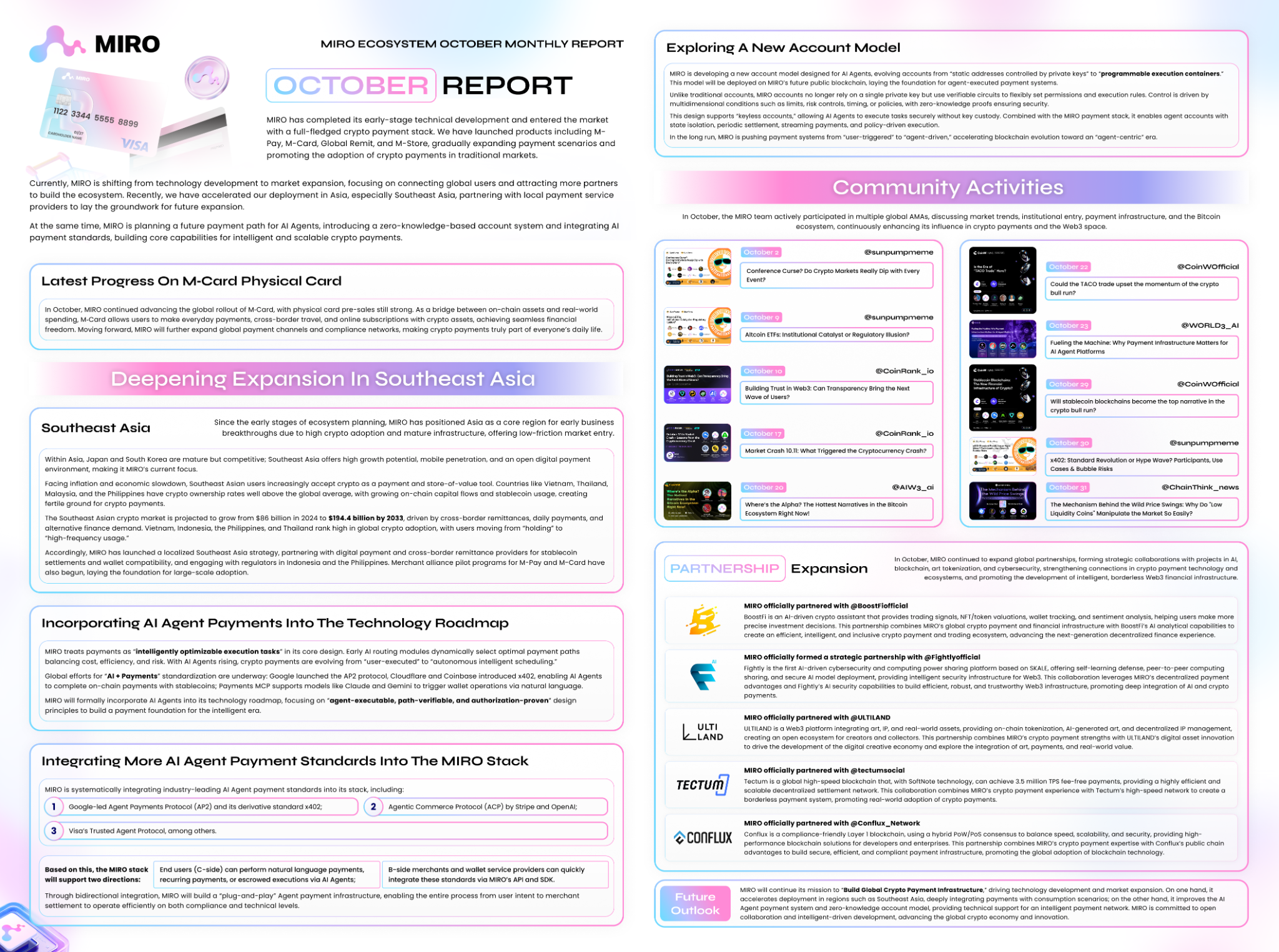
At present, the MIRO ecosystem has largely completed its early-stage technical development and entered the market as a fully structured crypto payment stack. Supported by this foundational architecture, we launched the M-Pay crypto payment module earlier this year for C-end users, laying the groundwork for the ecosystem’s practical adoption. Subsequently, the team introduced additional functional modules — M-Card, Global Remittance, and M-Store — gradually enriching payment scenarios, connecting the consumption chain, and promoting the large-scale adoption of crypto payments across traditional payment and retail markets.
At this stage, MIRO’s core focus has shifted from technology building to market expansion. We aim to further connect global C-end users while attracting more B-end partners to join and drive the ecosystem’s growth together. Over the past two months, our market efforts have deepened across Asia, with Southeast Asia becoming one of the primary regions of strategic focus. We are establishing initial partnerships with several local payment service providers to lay the groundwork for large-scale market penetration and localization in the coming phases.
Meanwhile, we have also clarified the future payment roadmap for AI Agents. In upcoming technical iterations, MIRO will launch a Zero-Knowledge (ZK)-based account system and gradually integrate a series of AI payment standards into its foundational stack, building the core infrastructure for crypto payment adoption in the age of intelligent agents.
Latest Progress on M‑Card Physical Card
In October, MIRO continued advancing the global rollout of M‑Card, with physical card pre-sales still in full swing. As a key bridge connecting on-chain assets with real-world consumption, M‑Card enables users to make everyday payments, cross-border travel, and online subscriptions using crypto assets, achieving seamless integration of funds freedom and real-life usage scenarios. Moving forward, MIRO will further expand M‑Card’s payment channels and compliance network worldwide, making crypto payments truly part of everyone’s daily life.
Deepening Southeast Asia Market Expansion
In fact, from the earliest stages of ecosystem planning, MIRO identified Asia as the key region for its initial business breakthrough. This decision was based on two considerations: first, Asia’s relatively high level of crypto acceptance; and second, compared to emerging regions such as Latin America and Africa, Asia’s more developed infrastructure enables faster product deployment with higher execution efficiency and lower friction costs.
Within Asia, developed markets such as Japan and South Korea have already established mature crypto regulatory frameworks and increasingly complete crypto payment industry chains. However, these markets are also transitioning from “blue oceans” to highly competitive “red oceans.” Therefore, at the current stage, our strategy has shifted further toward Southeast Asia, leveraging its high growth potential, high mobile penetration, and open digital payment environment as key entry points for ecosystem expansion.
Southeast Asia is currently facing notable inflationary pressure and slowing economic growth. For example, in 2024, the average inflation rate across eight Southeast Asian countries stood at around 5.0%, with Laos reaching as high as 23.1%. At the same time, growth is decelerating — according to S&P Global Ratings, the region’s economic growth rate is expected to fall by about 0.4 percentage points in 2025 to 4.5%. Persistently high inflation and slowing growth not only pose structural challenges for expanding payment and consumption scenarios but also create conditions for higher crypto adoption in the region.
Indeed, Southeast Asia is one of the world’s most crypto-friendly regions. Its user base and payment behaviors have reached critical mass, providing fertile ground for the deployment of new crypto payment systems.
Data shows that the crypto ownership rates in Vietnam (17.4%), Thailand (17.6%), Malaysia (14.3%), and the Philippines (13.43%) are all significantly above the global average. The psychological barrier for using crypto assets as a medium for payment and consumption is rapidly decreasing. By 2025, it is projected that around 40% of global consumers will have tried crypto payments at least once, with the Asia-Pacific region expected to be one of the largest contributors.
At the same time, on-chain capital flows and stablecoin usage are showing strong growth. Between 2024 and 2025, the total on-chain crypto value received in the Asia-Pacific region (with Southeast Asia as the main growth driver) increased by 69% year-over-year, reaching USD 2.36 trillion. Stablecoins such as USDT and USDC dominate this value flow, and their usage in crypto payment gateways grew by over 75%. This provides a high-liquidity settlement environment and accelerates the adoption of stablecoin-based payments in retail and cross-border use cases.
From an industry-wide perspective, the Southeast Asian crypto market reached USD 86 billion in 2024 and is expected to grow to USD 194.4 billion by 2033, representing a CAGR of 8.50% between 2025 and 2033. Key growth drivers include cross-border remittances, everyday payments, and alternative financial services for the unbanked population. Together, these are propelling Southeast Asia to become the world’s fastest-growing crypto payment gateway market, accounting for roughly 25% of global market share.
According to the Chainalysis 2025 Global Adoption Index, Vietnam, Indonesia, the Philippines, and Thailand rank 4th, 7th, 9th, and 17th globally, respectively — with high levels of on-chain retail activity and DeFi participation. This indicates that Southeast Asian users are not only “holding crypto assets” but are also actively using them — particularly for remittances, micropayments, and cross-border commerce. As of the first half of 2025, global crypto payment transaction volume reached 644,578 transactions, with a monthly peak nearing 118,000, and the Asia-Pacific region’s share continues to rise. Payment and remittance applications have become critical growth engines across the region.
Against this backdrop of high ownership rates, strong on-chain participation, explosive stablecoin usage, and rising cross-border payment demand, an accelerated adoption channel for crypto payments is forming — and this is precisely why MIRO is actively expanding into Southeast Asia.
MIRO has officially launched its localization strategy for the Southeast Asian market. We have already reached preliminary cooperation agreements with two regional digital payment network providers and three cross-border remittance and e-commerce payment gateway providers. These collaborations cover stablecoin settlement integration, local wallet compatibility, on-ramp access for users, and pilot programs for small-value, high-frequency transactions.
Additionally, we are in deep discussions with licensed virtual asset compliance institutions in Indonesia and the Philippines regarding regulatory sandbox mechanisms and licensing collaboration, ensuring that regional expansion maintains both speed and regulatory alignment.
Furthermore, we have launched the Southeast Asia Merchant Alliance Pilot Program, opening M-Pay and M-Card trial access for sectors such as entertainment, cross-border e-commerce, and digital subscription services, establishing the first batch of commercial user samples for large-scale deployment in the near future.
Integrating AI Agent Payments into the Technical Roadmap
In MIRO’s initial protocol design, payments were viewed as “executable tasks that can be optimized intelligently.” Therefore, early versions introduced an AI routing module, allowing the system to dynamically select the optimal payment path balancing cost, execution efficiency, and risk. However, with the rapid rise of agent-based intelligent systems (AI Agents) in autonomous decision-making and value execution, we realized that the future of crypto payments will no longer be limited to “executing transactions for users,” but will move toward a new stage where “intelligent agents autonomously schedule payment behaviors.”
Recently, multiple institutions worldwide have started promoting the standardization of “AI + Payments”: Google proposed the AP2 protocol to regulate agent payment flows. Building on this, Cloudflare and Coinbase launched x402, enabling AI Agents to execute native on-chain payments with stablecoins. Currently, Coinbase’s Payments MCP, based on x402, allows models such as Claude and Gemini to trigger wallet transactions directly via natural language. This indicates that “AI-driven payment execution” is moving from concept to viable products, becoming a core trend for future payment networks.
As a foundational protocol committed to building a crypto payment stack, MIRO plans to integrate AI Agents into its technical roadmap, with systematic architecture upgrades around agent-executability, path verifiability, and authorization proof.
Incorporating More AI Agent Payment Standards into the MIRO Stack
MIRO is systematically integrating industry-leading AI Agent payment standard frameworks into our stack, including:
The open protocol Agent Payments Protocol (AP2), launched by Google together with over 60 financial and payment institutions, and derived crypto payment standards such as x402.
The Agentic Commerce Protocol (ACP), developed in collaboration by Stripe and OpenAI.
The Trusted Agent Protocol initiated by Visa.
Based on this, the MIRO stack will support two key dimensions:
On the one hand, C-end users can complete payments directly via AI Agents in various scenarios—whether natural language triggers, recurring payments, or agent-managed execution;
On the other hand, B-end users (e.g., merchants, wallet providers, payment gateways) can quickly integrate these standards using MIRO’s APIs and SDKs, fully leveraging AI Agent-driven payment capabilities.
Through this dual integration, our system does more than adopt standards—it becomes a “plug-and-play” AI Agent payment infrastructure, making the full chain from user intent to backend agent execution and merchant settlement operationally feasible both technically and compliantly.
Exploring a New Account Model
MIRO is currently exploring a new account model designed for AI Agents, aiming to evolve accounts from “static addresses controlled by private keys” into “programmable execution logic containers.” This model will be deployed in future iterations of the MIRO public chain, laying the foundational infrastructure for agent-executed payment systems.
Traditional on-chain account models are based on single private key control. This structure will struggle to support complex authorization, multi-role interactions, and verifiable execution behaviors in a future dominated by AI Agents. Therefore, MIRO’s design direction is moving from “algorithmically fixed authentication” to “circuit-level programmable verification,” allowing accounts to express permission logic and execution rules freely through verifiable circuits.
In this model, account control is no longer determined by a single private key but can embed multi-dimensional programmable conditions, such as: payments must meet limit and risk score thresholds, contract calls restricted to time windows, and agent execution must conform to strategy curves (e.g., slippage caps or gas cost ranges). These rules are encoded into the account verification circuit and validated through zero-knowledge proofs during execution, ensuring security boundaries without exposing keys or strategies.
Furthermore, this model can evolve into a “keyless account” form, where execution rights are determined by “rule satisfaction + verification pass” rather than a private key held by any single entity. This allows AI Agents to act as trusted on-chain executors without human key custody, with permissions fully defined by logical boundaries.
Integrated with MIRO’s payment stack, this account structure will combine with path execution and state isolation mechanisms, allowing agent accounts to maintain independent contexts that affect only their own execution outcomes, providing a composable foundation for multi-agent collaboration, delegated settlements, and autonomous payment networks. Based on this, MIRO will prioritize two directions: building an Agent payment stack for periodic or streaming settlements, and advancing full-chain agent DeFi for strategy execution and position rebalancing under zero-knowledge verification.
From a long-term strategic perspective, MIRO uses payments as an entry point to gradually evolve AI Agents into independent economic entities on-chain, pushing payment systems from “user-triggered” toward “agent-driven” and accelerating the shift of blockchain collaboration logic from “human-centered” to “agent-centered.”
Community Activities
In October, the MIRO team remained active in global communities, participating in multiple AMA events covering market trends, institutional adoption, payment infrastructure, and the Bitcoin ecosystem. Through exchanges with project teams and industry media, MIRO continues to strengthen its influence in crypto payments and Web3 infrastructure.
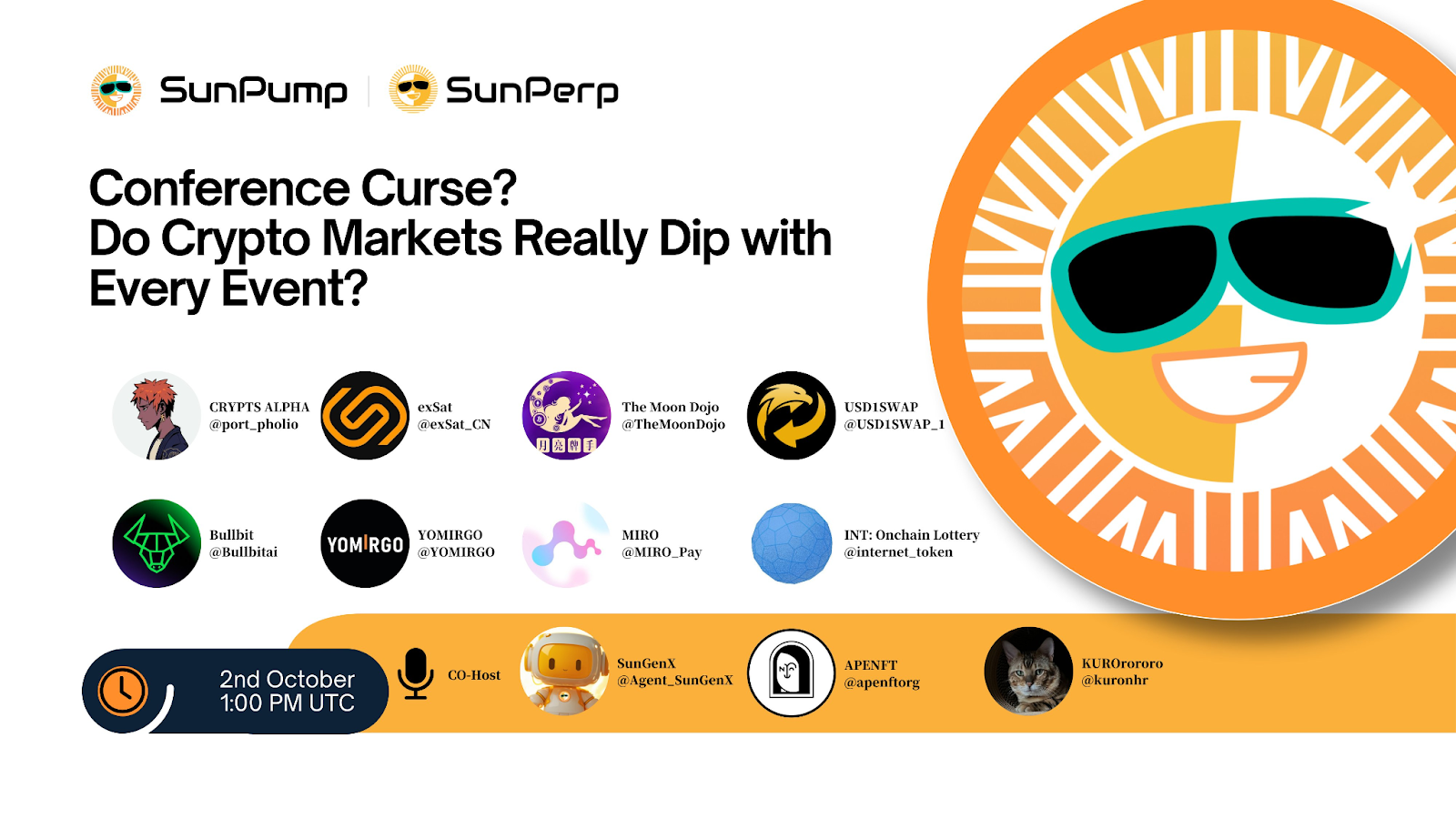
Organizer: @sunpumpmeme
Time: October 2 at 1 PM UTC
Topic: Conference Curse? Do Crypto Markets Really Dip with Every Event?
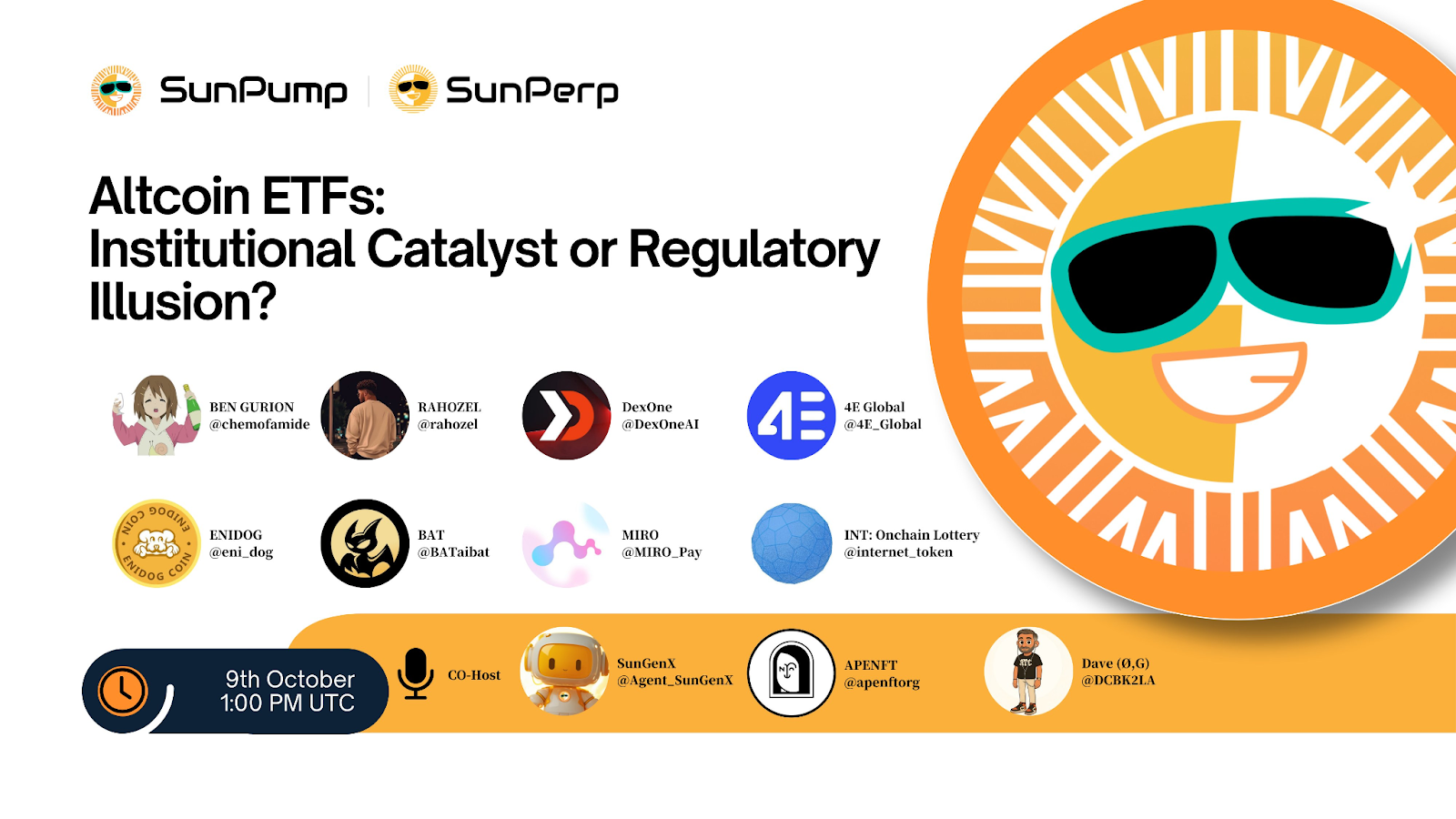
Organizer: @sunpumpmeme
Time: October 9 at 1 PM UTC
Topic: Altcoin ETFs: Institutional Catalyst or Regulatory Illusion?
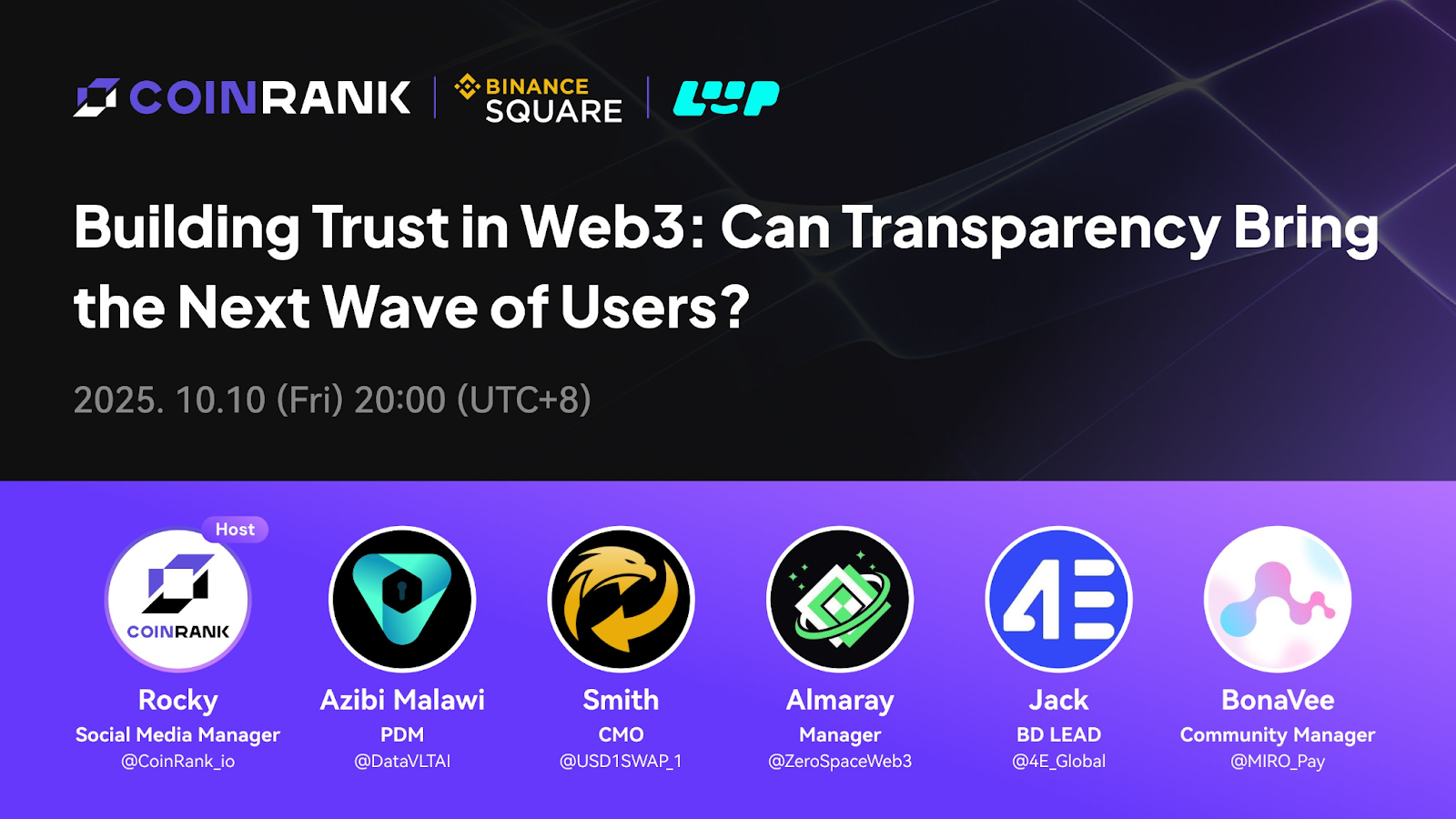
Organizer: @CoinRank_io
Time: Oct 10 (Fri) | 8:00 PM UTC+8
Topic: Building Trust in Web3: Can Transparency Bring the Next Wave of Users?
Organizer: @CoinRank_io
Time: October 17 (Fri), 2025 | 8:00 PM UTC+8
Topic: Market Crash 10.11: What Triggered the Cryptocurrency Crash?

Organizer: @FomowellX
Time: October 20th, 2:00 PM UTC
Topic: Where’s the Alpha? The Hottest Narratives in the Bitcoin Ecosystem Right Now!

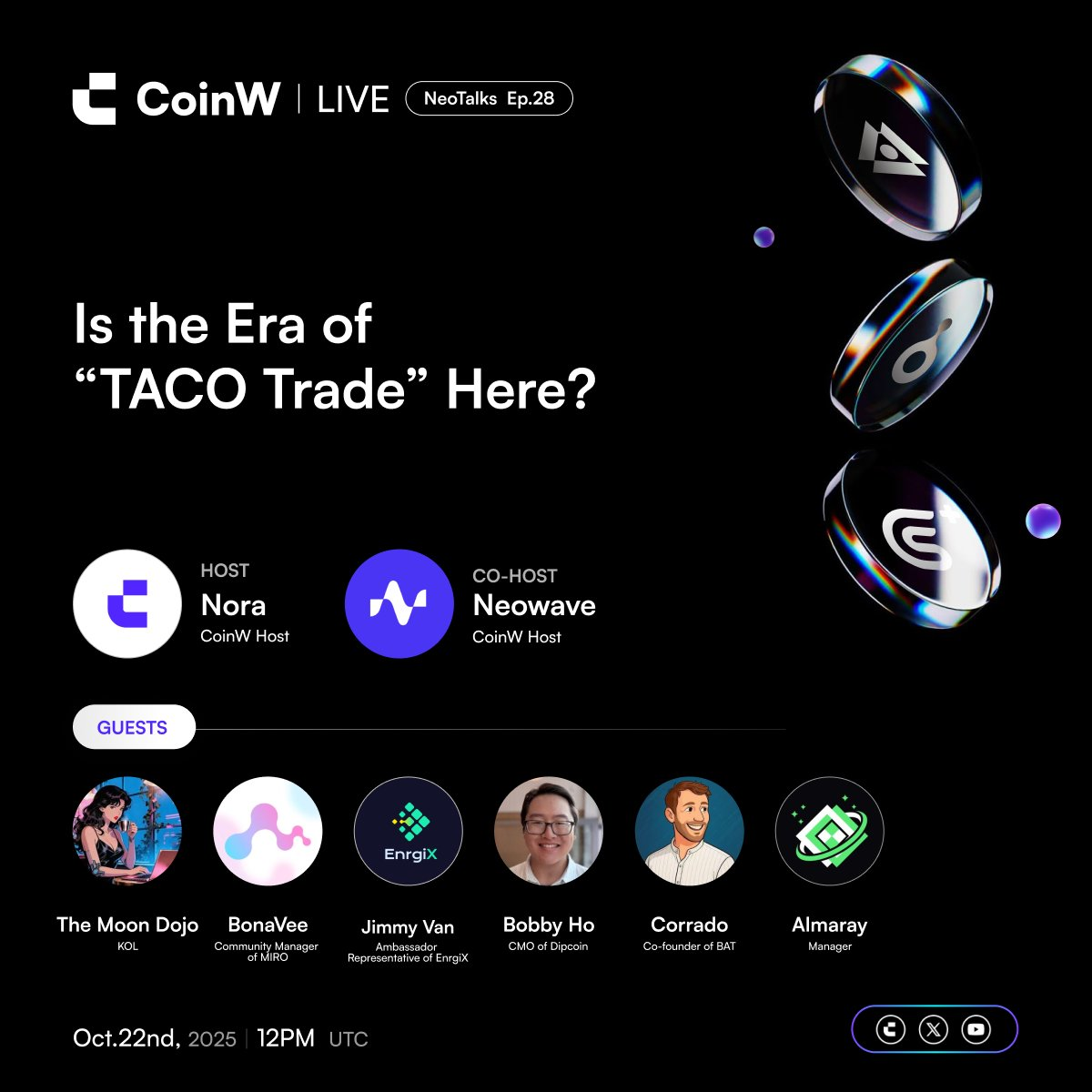
Organizer:@Cwinoffcial
Time: Oct 22 (Wed) | 12 PM UTC
Topic: Could the TACO trade upset the momentum of the crypto bull run?
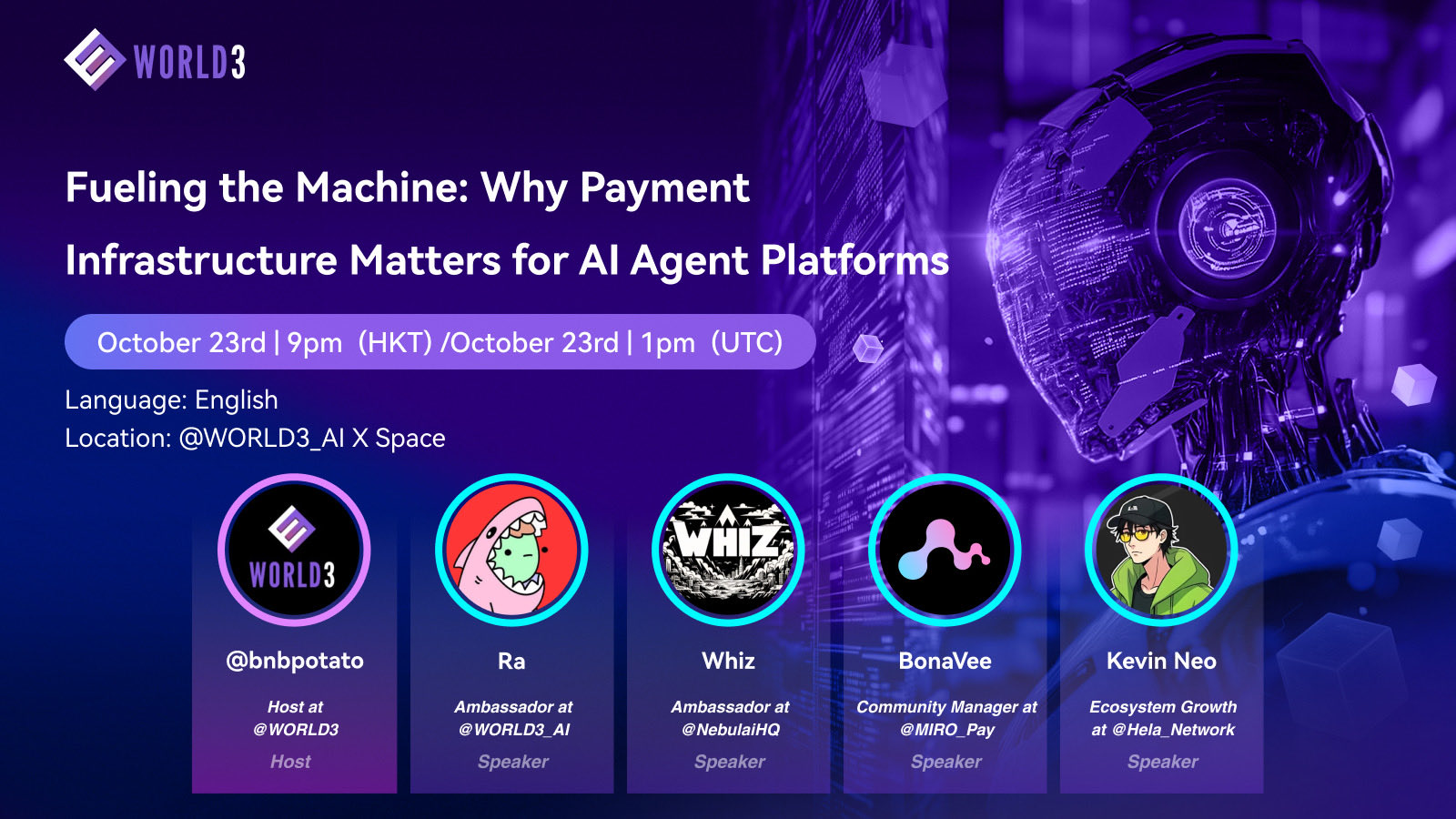
Organizer: @WORLD3_AI
Time: Oct 23rd | 1 PM UTC | 9 PM HKT
Topic: Fueling the Machine: Why Payment Infrastructure Matters for AI Agent Platforms
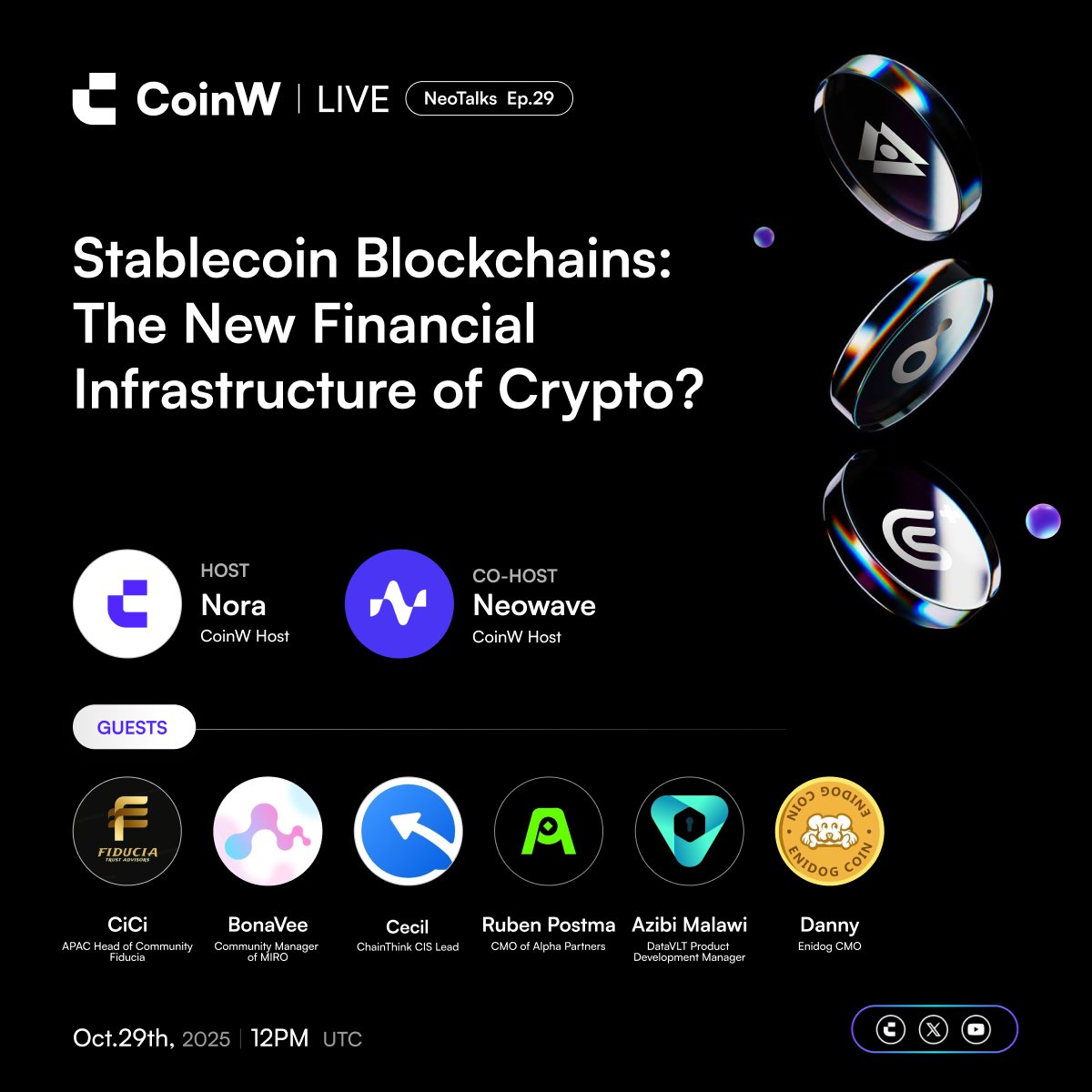
Host: @CoinWOfficial
Time: October 29 | 12PM UTC
Topic: Will stablecoin blockchains become the top narrative in the crypto bull run?
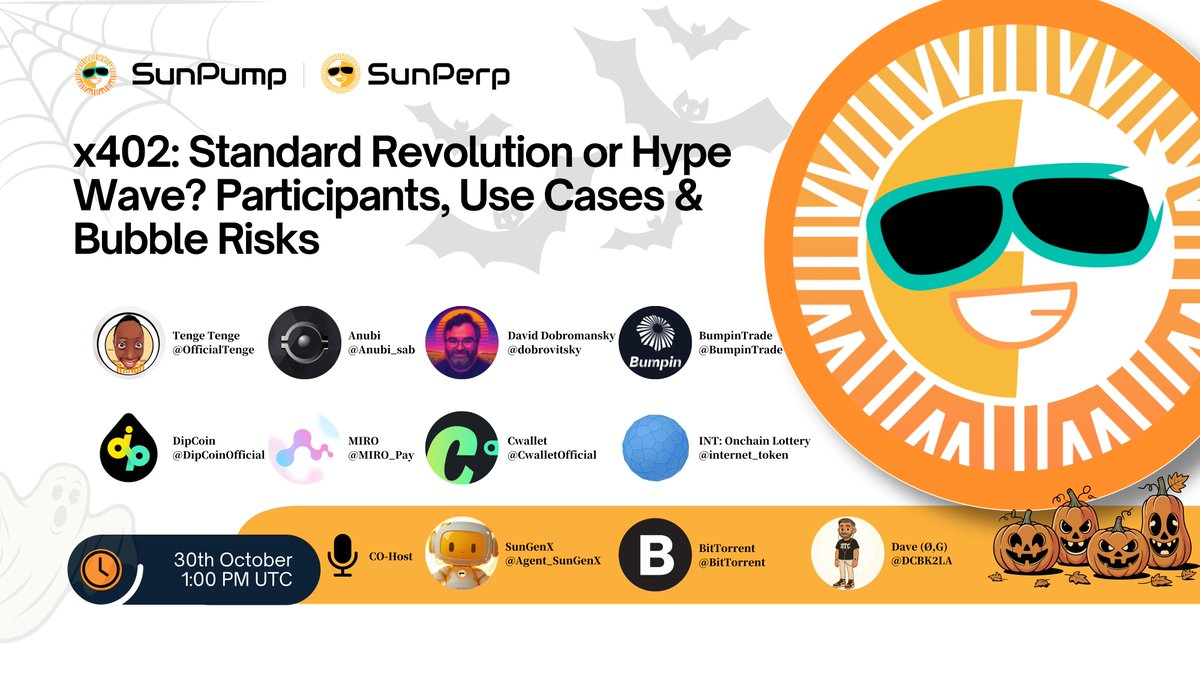
Host: @sunpumpmeme
Time: October 30 | 1 PM UTC
Topic: x402: Standard Revolution or Hype Wave? Participants, Use Cases & Bubble Risks
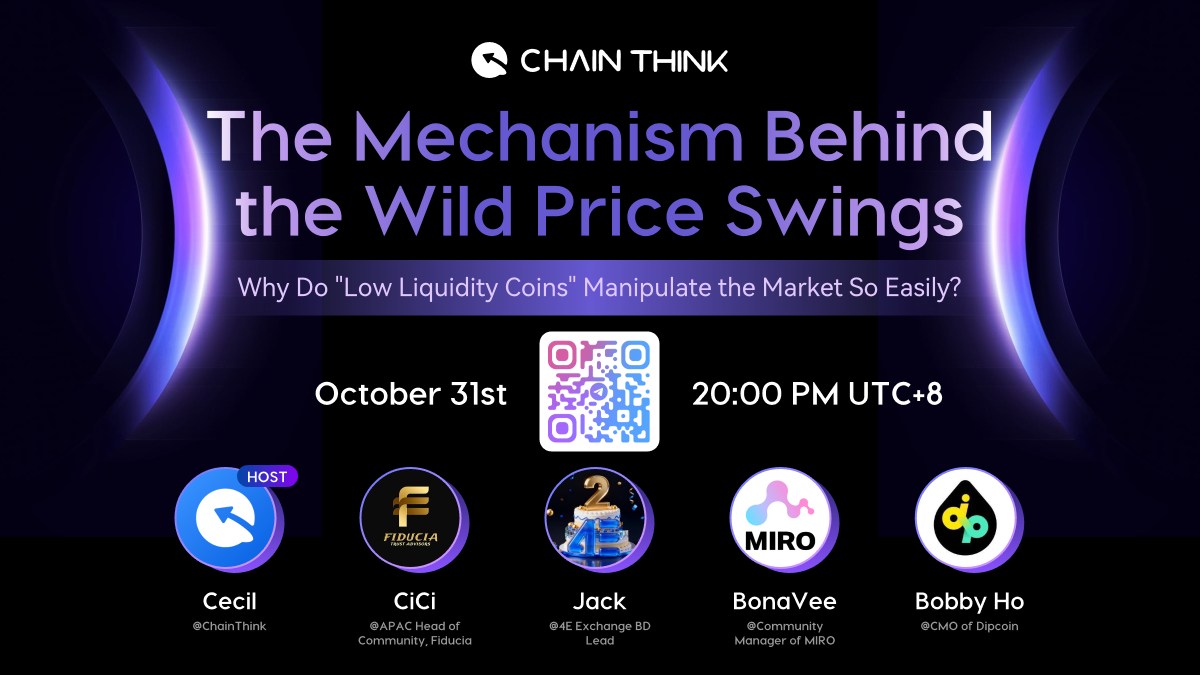
Host: @ChainThink_news
Time: October 31 | 8:00 PM UTC+8
Topic: The Mechanism Behind the Wild Price Swings: Why Do "Low Liquidity Coins" Manipulate the Market So Easily?
Expansion of Partnerships
Entering October, MIRO continues to expand its global ecosystem of partnerships, establishing strategic collaborations with multiple outstanding projects across AI, blockchain infrastructure, art asset tokenization, and cybersecurity. Through deep cooperation with industry-leading partners, MIRO continuously strengthens the technical foundation and ecological connectivity of its crypto payment system, jointly promoting the next stage of intelligent and borderless Web3 financial infrastructure.
**MIRO officially partners with @BoostFiofficial
**BoostFi is an AI-driven intelligent crypto assistant that integrates multiple functions, including trading signal generation, NFT and token valuation, smart wallet tracking, and sentiment analysis, providing users with more efficient and intelligent investment support. The platform is committed to empowering the crypto market with AI, helping users make more precise decisions in complex market environments.
This partnership will leverage MIRO's strengths in global crypto payments and financial infrastructure, complementing BoostFi's AI analytics capabilities, to jointly advance the Web3 intelligent finance ecosystem. Both parties will work together to create a more efficient, intelligent, and inclusive crypto payment and trading environment, integrating smart strategies with borderless payments for the next generation of decentralized finance experiences.
MIRO officially partners with @Fightlyofficial
Fightly is the first AI-driven cybersecurity and computing power sharing platform built on the SKALE Network, combining self-learning AI defense, peer-to-peer computing power sharing, and secure AI model deployment to provide a new intelligent security infrastructure for the Web3 ecosystem.
This collaboration will integrate MIRO’s technological advantages in decentralized payments and financial infrastructure with Fightly’s innovation in AI security and computing networks, jointly promoting the construction of intelligent and secure Web3 infrastructure. Both parties aim to build a more robust, efficient, and trustworthy decentralized future, laying a solid foundation for the deep integration of AI and crypto payments.
MIRO officially partners with @ULTILAND
ULTILAND is a next-generation Web3 platform integrating art, IP, and real-world assets, providing on-chain assetization, AI-generated art, and decentralized IP management to create an open ecosystem for creators, collectors, and brands with both liquidity and creativity.
This partnership will combine MIRO’s expertise in crypto payments and on-chain financial infrastructure with ULTILAND’s innovative practices in digital art and real-world asset tokenization, jointly promoting the development of the digital creative economy. Both parties will explore the integration of art, payments, and real-world value, helping Web3 enter a new stage of creativity and value connectivity.
MIRO officially partners with @tectumsocial
Tectum is one of the fastest blockchains globally, with its SoftNote technology capable of 3.5 million TPS fee-less payments, bringing unprecedented efficiency and scalability to crypto payments. The platform’s innovative Proof of Utility consensus mechanism aims to build a high-performance, low-cost decentralized settlement network.
This collaboration will combine MIRO’s experience in global crypto payments and settlement infrastructure with Tectum’s high-speed network capabilities to create a new generation of borderless payment systems. Both parties will promote the real-world adoption of crypto payments and accelerate the construction of an efficient, secure, and open digital economy.
MIRO officially partners with @Conflux_Network
Conflux is a compliance-friendly Layer 1 blockchain that uses a unique hybrid PoW/PoS consensus mechanism to balance speed, scalability, and security. As a key infrastructure connecting decentralized economy and real-world finance, Conflux aims to provide global developers and enterprises with high-performance and compliant blockchain solutions.
This partnership will integrate MIRO’s expertise in global crypto payment and settlement networks with Conflux’s leading performance and compliant ecosystem, jointly building secure, efficient, and compliant crypto payment infrastructure. Both parties aim to accelerate the global adoption of blockchain technology and move towards a borderless intelligent financial era.
Future Outlook
MIRO will continue to focus on its core mission of "building global crypto payment infrastructure," driving both technology R&D and market expansion. On one hand, we will accelerate local deployments in key regions such as Southeast Asia, promoting the deep integration of payment systems with real-world consumption scenarios. On the other hand, we will continue to refine the AI Agent payment system and zero-knowledge account model, laying the technological foundation for intelligent and verifiable payment networks. We firmly believe that the future of decentralized finance belongs to open collaboration and intelligence-driven innovation, and MIRO will continue to advance in this process, helping the global crypto economy achieve higher levels of connectivity and innovation.